Implementation guide
Resilient operations and continuous adaptation
One model for bringing new ideas to market, managing the risks that come with them, and organizing work between people and AI: discover, experiment and learn, then operate, adapt and scale.
Innovation and resilience are the same discipline
Most organizations run innovation and risk as separate tracks. One team looks for new products, markets and ways of working. Another looks for what could go wrong. They use different language, different evidence and different timelines, and often meet only when a launch is already late or a risk has already landed.
That separation is getting harder to afford. AI, new business models and converging markets are creating opportunities faster, and every one of them changes the organization's exposure: new dependencies, new partners, and decisions made by systems rather than people. AI is also changing who does the work, so the way work is organized has to keep changing too.
This model brings both into one cycle. Discover how work creates value and where it is exposed. Experiment to test new offerings and new ways of operating before committing to them. Then operate, adapt and scale, with evidence of both what is working commercially and what the organization can withstand.
The pages that follow show each phase through both lenses, innovation and commercialization alongside risk and resilience, and close with a practical first cycle and the roles that make it work.
The work that finds the next opportunity should also show what it takes to run it with confidence.
- Separate innovation and risk tracks→One shared cycle
- Launch first, assess risk later→Test opportunity and exposure together
- Big-bang rollouts→Small, tested experiments
- Plans as evidence→Measured results
- Fixed operating model→Continuous adaptation
- People checking AI at the end→Governance designed into the work
Three phases, used for innovation and resilience alike. Discover how work creates value and where it is exposed. Experiment with new offerings and ways of working before committing to them. Then operate, adapt to what you learn, and scale what works.
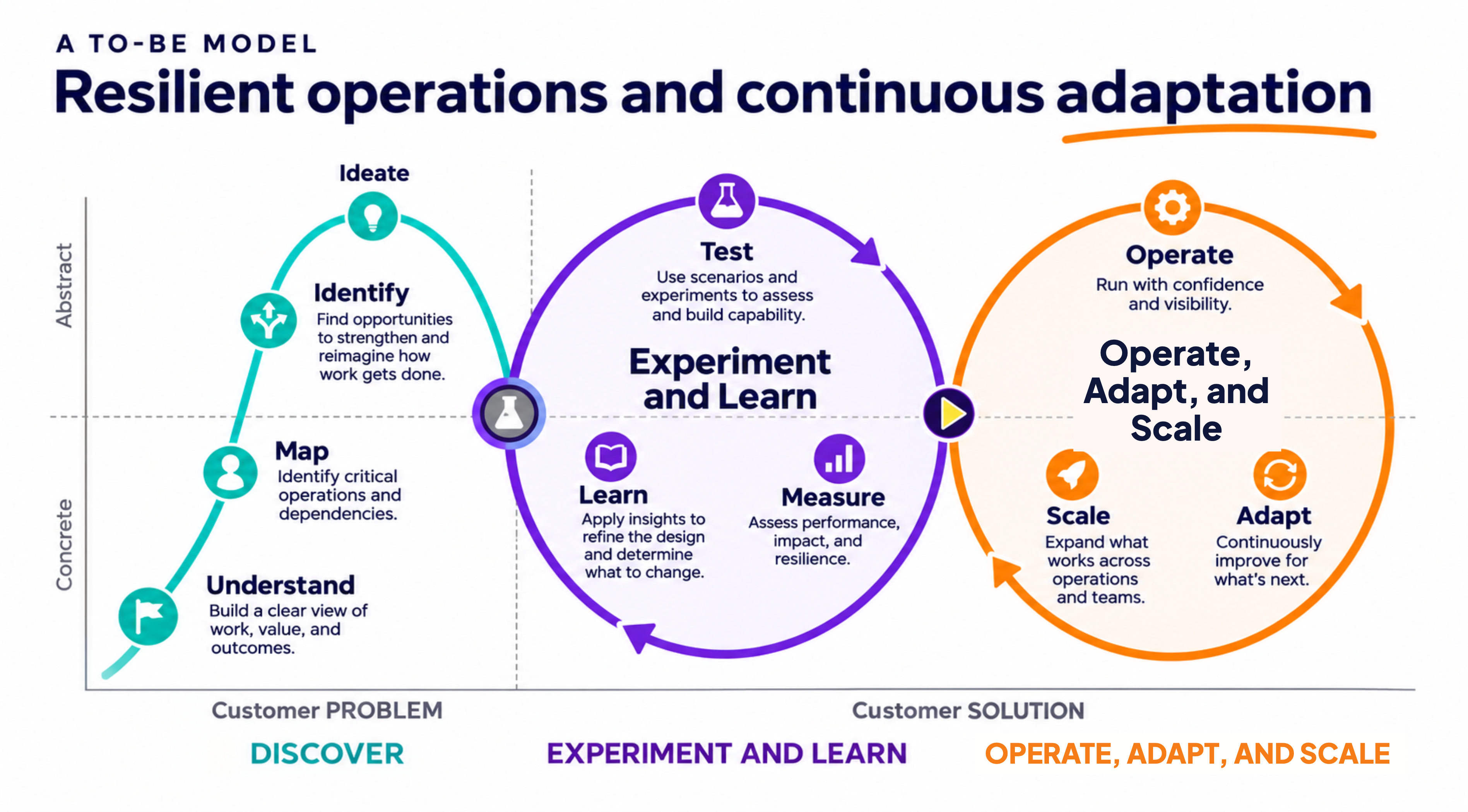
Each phase serves growth and resilience at once
| Phase | The question it answers | Innovation & commercialization | Risk & resilience |
|---|---|---|---|
| Discover | How does our work create value, and where is it exposed? | Where customer needs, technology or markets are opening new opportunities | Which operations, dependencies and partners the business cannot afford to lose |
| Experiment and learn | Does the new approach work the way we expect? | Test propositions, pricing, channels and new ways of working with real customers | Test how people and systems respond to disruption before it happens |
| Operate, adapt and scale | How do we run it, grow it and keep it current? | Scale what customers adopt and build it into the commercial engine | Embed the ownership, controls and visibility that let it run with confidence |
Three principles that run through all of it
- Start concreteGround ideas in how work and value are created today before redesigning either.
- Test before you scaleSmall experiments show how customers, people and systems actually respond.
- Keep the loop runningMarkets and risks keep moving. The cycle feeds back into discovery.
Each phase asks a new question
| Phase | The question it adds | What changes in practice |
|---|---|---|
| Discover | What can we accomplish when human and AI capabilities are considered together? | Map today’s work, but don’t assume today’s tasks are the units future operations should be built around |
| Experiment and learn | How well does the combined system perform, decide and hold up? | Test different arrangements of people and AI, not just whether a tool can do one task |
| Operate, adapt and scale | How should the division of work, decision rights and controls change as capabilities change? | Revisit who or what does the work, decides, verifies and is accountable |
Three design principles
- Design around outcomesAsk which constraints have disappeared and what has become possible, rather than which existing tasks AI can take.
- Experiment with the operating modelMeasure quality, effort and new value from each arrangement of people and AI, then refine it.
- Keep reassigning capabilityResponsibilities are not fixed. Keep the expertise to step in when automation fails.
Each step draws on both
| Step | AI contribution | Human contribution |
|---|---|---|
| Understand | Synthesize signals, analyze information, detect patterns | Set strategic intent, interpret context, challenge assumptions |
| Map | Map dependencies, workflows, capabilities and constraints | Decide which relationships, decisions and capabilities matter |
| Identify | Surface newly feasible opportunities | Choose the problems worth solving and define value |
| Ideate | Generate options, prototypes and alternatives | Weigh trade-offs and apply expertise |
| Test | Run repeatable evaluations and simulations | Set success criteria and examine exceptions |
| Measure | Track performance and detect drift | Judge consequences and what the evidence means |
| Learn | Recommend changes based on results | Decide what to change and why |
| Operate | Execute, monitor and improve within set limits | Exercise judgment, handle material exceptions, stay accountable |
| Adapt | Detect changing conditions and suggest modifications | Revisit assumptions, redesign capabilities, redirect investment |
| Scale | Reproduce validated capabilities and orchestrate workflows | Set decision rights, boundaries and resource commitments |
Design governance into the work
- Design timePeople set objectives, standards, acceptable risks and decision rights.
- Run timeAI works within those limits, with automated controls, evidence capture and escalation.
- ContinuouslyPeople and AI review performance, spot changing risks and revise the system.
Accountability doesn’t require a person to touch every output. Some decisions need individual approval; others are better assured by monitoring and agreed controls.
An example: moving a content library
| Approach | How it works | What it leads to |
|---|---|---|
| Review everything by hand | Experts check every item before it moves to the new library | Review capacity caps growth, and the old process carries over |
| Standards first | Experts set standards. AI migrates, checks and flags exceptions. Experts handle what matters and create new content | A library that keeps improving, with expert time spent on new value |
Capability orchestration, across every phase
- Who leadsWhich decisions should be human-led, AI-led or shared?
- Build or retireWhich capabilities to build, buy, automate or retire?
- AttentionWhere is human expertise most valuable?
- EvidenceWhat shows the arrangement works?
- RedesignWhen does a new AI capability justify changing the process itself?
Move from concrete to abstract
| Step | What you do | Innovation & commercialization | Risk & resilience |
|---|---|---|---|
| Understand | Build a clear view of the work, the value it creates and the outcomes customers depend on | Which outcomes customers value most and will pay for | Which outcomes must keep working through a disruption |
| Map | Trace how the work happens across people, systems, data, partners and customers | Where the value chain could be redesigned or extended | Where one supplier, person or connection creates an outsized exposure |
| Identify | Find opportunities to strengthen the operation and reimagine how work gets done | New offerings, markets or ways of working worth pursuing | Weaknesses the business has learned to tolerate |
| Ideate | Develop options, including ones that change the operating model | Hypotheses about demand, price and channel | Hypotheses about how the organization would respond |
Questions for the leadership team
- DemandWhat are customers starting to need that we don’t offer yet?
- CombinationWhich of our capabilities would be worth more combined with someone else’s?
- ExposureWhere would a single failure hurt customers most?
- DriftWhich dependencies have we added without deciding to?
- AssumptionsWhat are we assuming will stay the same?
Test, measure, learn, and run it again
| Step | What you do | Innovation & commercialization | Risk & resilience |
|---|---|---|---|
| Test | Use pilots, scenarios and small experiments with real people and realistic conditions | Pilot the proposition with a small set of customers | Run scenarios that put the response under realistic pressure |
| Measure | Assess performance and impact against what you expected | Adoption, willingness to pay, sales cycle and margin | Time to decide, time to recover and repeat friction |
| Learn | Apply the evidence to refine the design and decide what to change | Refine the offer, pricing and go-to-market | Fix handoffs, ownership and dependencies, then re-test |
What makes a useful experiment
- 1 SpecificIt tests one assumption the idea depends on.
- 2 RealisticIt uses real customers, real people and realistic conditions.
- 3 FrequentShort, regular tests teach more than one large pilot.
- 4 ObservedSomeone records decisions, objections and handoffs as they happen.
- 5 RepeatedThe test returns later to show whether changes held.
Run it with confidence, then widen it
| Step | What you do | Innovation & commercialization | Risk & resilience |
|---|---|---|---|
| Operate | Build what proved itself into routines, ownership and reporting | Hand the offer to sales, marketing and delivery with clear targets | Clear owners, visible status and decisions that don’t wait for a crisis |
| Adapt | Adjust to what operation shows before you scale, and keep reviewing afterward | Pricing, packaging and positioning as the market moves | New dependencies, regulation and threats |
| Scale | Extend what works across teams, markets, sites and partners | New segments, regions and channels in order of evidence | Controls and practice that grow with the operation |
Signals that it is time to adapt
- New capabilityA new technology or AI capability makes a different offer, way of working or division of work possible.
- Market shiftCustomer expectations, competitors or regulation have moved.
- New dependencyA new supplier, platform or AI tool has become part of a critical operation.
- Changed operationA reorganization, acquisition or new service has moved where value is created.
- Repeated frictionThe same objection, handoff or delay keeps appearing.
A first cycle in seven steps
- 1Name an executive sponsor and agree the outcomes that matter most
- 2Pick one opportunity and the operations it depends on
- 3Map value and dependencies with the people who run them
- 4Choose the commercial and operational assumptions most likely to be wrong
- 5Run a small experiment on each, including how people and AI share the work, and record what happens
- 6Make two or three owned changes
- 7Re-test, then decide what to scale
Who owns what
| Role | Owns | In practice |
|---|---|---|
| Board | Oversight of growth and risk together | Asks for evidence that new initiatives are working and that the exposure they create is understood |
| Executive sponsor | Priorities, funding and removing obstacles across functions | Makes sure innovation and risk teams work from the same evidence |
| Commercial leaders | Propositions, pricing, channels and customer adoption | Run market experiments and own the commercial results |
| Operations leaders | The operations, their dependencies and changes to them | Run operational experiments and own the resulting changes |
| Process owners | How work is split between people and AI | Revisit the split as capabilities change |
| Risk and resilience partners | The method for testing exposure, and the evidence | Join experiments early and flag risks before they scale |
Measure results, not activity
| Measure | What it tells you | How to read it |
|---|---|---|
| Commercial traction | Adoption, revenue and margin from new offers | Judge against the hypothesis you tested, not the original forecast |
| Time to change | How quickly a tested idea becomes standard practice | Should shorten with each cycle |
| Repeat findings | Whether the same friction or objection keeps appearing | A finding that returns means the change did not hold |
| Dependency coverage | How much of each critical operation has been mapped and tested | Gaps usually sit with third parties and informal workarounds |
| Capability evolution | Whether the organization can now do things it couldn’t before | Hours saved alone won’t show it |
Common pitfalls
- Separate tracksInnovation and risk working from different evidence and meeting too late.
- Launch as proofTreating a rollout as evidence that customers or teams have adopted it.
- One big betA single large pilot that is too slow and too visible to learn from.
- Skipping discoveryTesting ideas before agreeing where value and exposure sit.
- Project mindsetDeclaring it finished when the first cycle ends.
- People in the gapsAdding human review to the old process instead of redesigning it.