When AI Exposes How Organizations Really Work
The biggest challenges in AI governance may reveal more about our management practices than our technology.

AI is revealing how many organizations actually operate, rather than how their organizational charts and policies suggest they operate.
As companies introduce AI into increasingly consequential business processes, familiar questions are becoming harder to avoid. Who has authority to approve changes? Who understands the implications for customers? Who owns decisions that cross functional boundaries? How does information move between technology, risk, legal, security, and the business? And who is accountable when something goes wrong?
These questions are regularly framed as emerging AI governance challenges. Some certainly are. AI introduces new technical characteristics, dependencies, and risks that require specialized expertise and oversight.
But many of the difficulties organizations are experiencing reflect longstanding weaknesses in management practices, decision rights, organizational communication, and accountability. AI is making those weaknesses more visible.
Technology is moving faster than organizational authority
Deloitte’s October 2026 research provides an interesting illustration. According to its latest State of AI in the Enterprise study, 40% of surveyed enterprises allow AI systems to execute decisions or take actions without human approval to at least a moderate degree. At the same time, nearly one-quarter report unclear accountability when AI produces a negative outcome.
This is a meaningful organizational disconnect. Companies are expanding the autonomy of technology while still resolving the question of who is accountable for its decisions and consequences.
The challenge becomes particularly acute when AI capabilities extend across multiple functions. Consider a customer-support team deploying an AI capability that can investigate reported issues, access internal information, recommend resolutions, and initiate operational actions.
The technology team may be responsible for implementation. Customer success may own the customer relationship. Legal may oversee contractual obligations. Security may be responsible for access controls. Risk may establish governance expectations. Each function has a legitimate role.
But who is responsible for assessing the combined impact of the new capability? Who verifies that the information accessed is appropriate for its intended purpose? Who determines whether customer commitments permit that use? Who evaluates the implications for service quality, escalation processes, and customer trust?
The answers should be reflected in the organization’s operating model. A new AI policy may establish important principles. The practical challenge is ensuring those principles influence everyday decisions.
The problem with governance as an additional layer
When organizations encounter emerging risks, a common response is to establish additional oversight structures. New committees, approval requirements, risk assessments, reporting processes, and policies are introduced. These mechanisms can provide necessary coordination and assurance, particularly when the technology creates unfamiliar exposures. They can also add complexity to an operating environment that is already fragmented.
Consider an organization with established processes for approving technology, managing third-party relationships, protecting customer information, and introducing operational changes. Where should AI governance sit?
A completely separate approval structure may create duplicated reviews, unclear authority, and inconsistent requirements. Embedding AI considerations into existing processes may be more efficient, provided those processes are functioning effectively and the organization has the necessary expertise. The right answer will vary depending on the risk, scale, and complexity of the organization.
What matters is the connection between governance structures and actual operational decisions. If a business can introduce a consequential AI capability without its relevant stakeholders understanding what has changed, the organization has a broader management problem. The technology has exposed it.
Decision rights matter more than committee membership
Much of the conversation about AI governance focuses on who should participate. Should responsibility sit with IT, the chief AI officer, legal, risk, compliance, or a dedicated governance committee? Participation matters, but the more important question concerns decision rights.
Who can authorize an AI system to access a new category of information? Who can approve a change in the level of autonomy granted to that system? Who determines whether human review is required? Who can suspend the capability when its behavior or consequences become unacceptable? And how are those decisions documented and communicated?
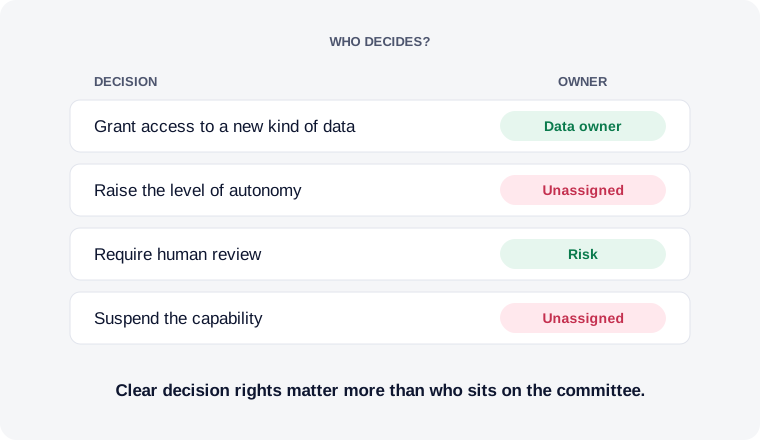
A governance model needs to establish where authority resides, what information decision-makers require, and how accountability is maintained. It also needs to reflect the reality that AI systems may change their operational impact without a corresponding change in the organization’s formal structure. A relatively small technical enhancement can create a substantial shift in business risk.
For example, moving from an AI tool that suggests a customer response to one that can initiate account changes introduces a new level of operational authority. The interface may look nearly identical. The business implications are quite different.
Organizational communication is becoming a control
Another underappreciated dimension of AI governance is communication. Many organizations have established processes for major technology deployments. But AI capabilities are increasingly being introduced through incremental enhancements, integrations, internal experiments, and changes to existing workflows. These changes may never appear on the agenda of a formal transformation program. Yet their cumulative impact can be substantial.
A team connects an AI assistant to an internal system. Another expands the data available to an existing application. A third begins using AI-generated outputs in a customer-facing process. Individually, each change may appear modest. Collectively, they can alter how information flows, how decisions are made, and how the organization delivers its services.
This makes communication about operational changes an increasingly important management control. Organizations need a practical way to surface material changes, assess cross-functional implications, and ensure relevant stakeholders understand what is happening. That requires judgment about which changes matter, who needs to know, and what level of review is appropriate. It also requires a culture in which teams are encouraged to communicate emerging capabilities and their consequences early.
AI governance as a test of management maturity
There is an opportunity here for leadership teams willing to look beyond the immediate technology challenge. AI governance discussions can provide useful insight into the effectiveness of the broader organization.
If decision rights are unclear, that ambiguity may affect other areas of the business. If operational changes are poorly communicated, similar weaknesses may exist in cybersecurity, customer experience, third-party management, and product development. If leaders struggle to identify who owns a cross-functional risk, they may have a more fundamental accountability issue.
Addressing these weaknesses can create benefits well beyond AI. It can improve coordination, accelerate responsible innovation, strengthen customer trust, and reduce friction between business and control functions. This is particularly important as organizations move toward AI systems capable of taking increasingly autonomous action. The quality of the underlying management system will influence how effectively that autonomy can be deployed.
Five questions for executive teams
Before commissioning another governance framework, leadership teams should consider five questions:
- Can we identify where AI is influencing or executing material business decisions? This includes AI capabilities embedded within existing systems and third-party services.
- Are decision rights clear? Can we identify who approves capabilities, autonomy, data access, operational changes, and exceptions?
- How are material changes communicated? Do relevant business, technology, risk, legal, and customer stakeholders understand changes that affect their responsibilities?
- Can we demonstrate accountability in practice? Are decisions, approvals, monitoring arrangements, and escalation paths documented and used?
- Are our existing management processes fit for purpose? Where does AI genuinely require new controls, and where should established processes be strengthened?
These questions help distinguish technology-specific governance requirements from broader organizational effectiveness issues. Both deserve attention.
A more useful starting point
AI will continue to introduce new challenges for organizations, including questions about autonomy, reliability, explainability, data protection, and oversight. Those challenges require deliberate governance. But the effectiveness of that governance will depend heavily on existing management capabilities.
An organization with clear accountability, effective communication, well-designed decision rights, and disciplined operational change processes has a stronger foundation for managing emerging technology. It is also better positioned to move quickly when new opportunities arise.
Perhaps one of AI’s most valuable contributions to management will be its ability to expose the organizational assumptions and practices that have gone unchallenged for years. The opportunity is to use that visibility to build a more capable enterprise.