What Happens When the Market Gets a Vote?
How participatory experiences reveal what customers actually value—and help companies build better solutions, stronger market positions, and new opportunities for growth.

Companies invest heavily in conferences. Between sponsorships, travel, exhibition space, creative development, and staff time, even a relatively modest industry event can represent a significant commercial investment.
Most companies evaluate that investment through leads generated, meetings booked, brand visibility, and pipeline influenced. These are useful measures. But they overlook one of the most valuable things a conference provides: concentrated access to the very people who determine whether your solution succeeds.
Customers, prospective buyers, industry experts, partners, and competitors are all in the same environment. They are there to exchange ideas, explore emerging challenges, and discover new approaches.
For companies introducing unfamiliar technologies, developing new products, or building new markets, this creates an opportunity that extends well beyond conventional event marketing.
A conference can become a live environment for validating ideas, improving solutions, understanding customers, and accelerating growth.
What we learned by making attendees part of the experience
At the Private Directors Association's PRISM conference in Atlanta, we introduced Director, Defined, an interactive assessment designed to explore how individual directors approach their responsibilities. Participants answered questions about their governance instincts and received a perspective on their own boardroom style.
The experience was designed to provide immediate value to directors while contributing to a broader understanding of governance behaviors. It also gave us something enormously valuable: direct insight into how our intended audience engaged with the concept.
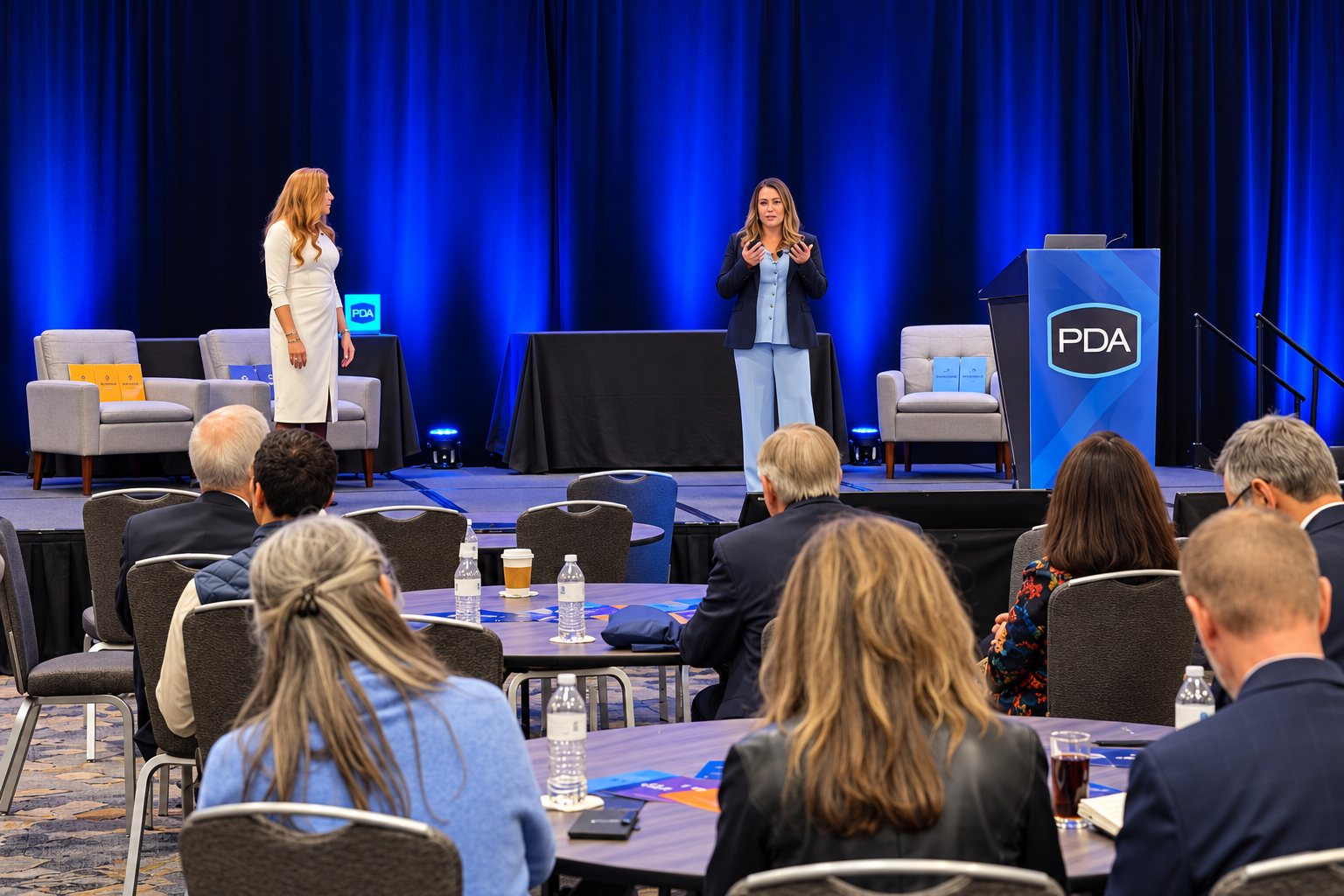
The questions generated reflection and discussion. Realistic situations encouraged directors to consider how they might respond to difficult boardroom decisions. We also discovered that some elements of the experience were more meaningful than others.
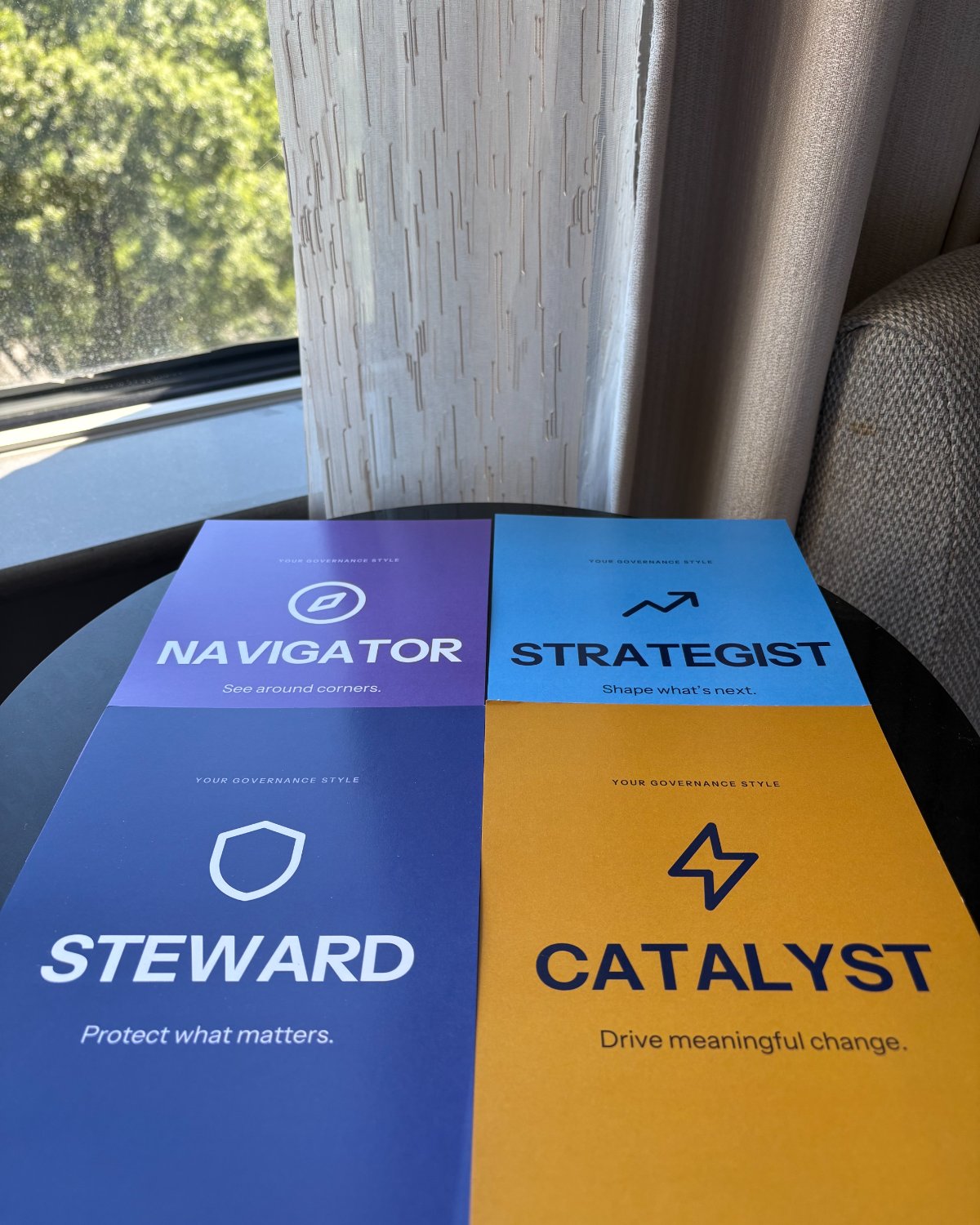
While the scoring and categorization helped frame the concept, participants appeared particularly interested in the questions themselves and the opportunity to explore thought-provoking scenarios. That distinction matters.
If we had simply demonstrated the assessment and measured how many people completed it, we would have captured engagement data. By paying attention to how people interacted with the experience, we gained insight that could influence the future direction of the offering.
The event helped us understand what people found valuable, what they wanted more of, and where the concept had room to evolve. Those lessons can inform product design, positioning, and future commercial opportunities.
The distance between what companies build and what customers value
One of the persistent challenges in bringing new solutions to market is that companies develop strong assumptions about what customers need. Those assumptions influence product features, messaging, pricing, and go-to-market strategies. But customers do not always value a solution in the way its creators expect.
A feature the development team considers essential may generate little interest. An unexpected use case may reveal a more attractive market. A question raised during a demonstration may expose a limitation that would otherwise go unnoticed.
This becomes particularly important in emerging categories, where customer expectations are still forming.
Traditional market research helps companies understand demand. Product testing helps evaluate functionality. Marketing campaigns help measure interest. Thoughtfully designed conference experiences can bring elements of all three together.
They allow organizations to observe how people engage with an idea, understand which aspects resonate, and explore the reasoning behind customer reactions. The result is a more informed picture of where the solution fits into the market.
Designing experiences that produce commercial intelligence
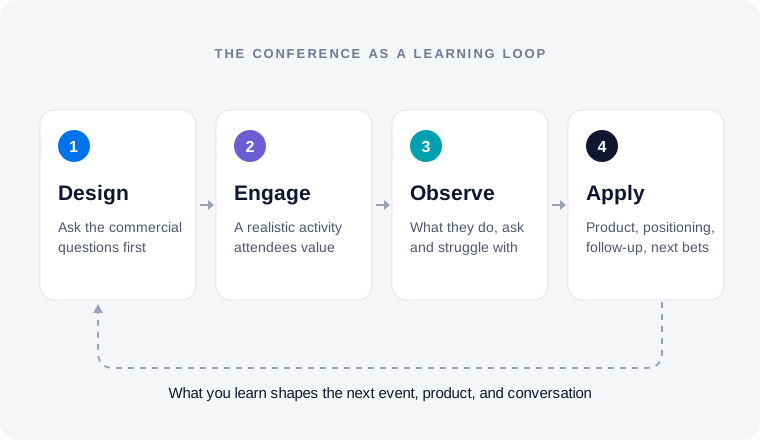
The most productive starting point for an industry event may be a set of commercial questions.
- Which customer problems are we best positioned to solve?
- What do prospective buyers understand about our solution?
- Which use cases create the strongest interest?
- What objections or uncertainties prevent adoption?
- Are we speaking to the right customer segments?
- What might make our solution easier to understand, buy, or use?
These questions can shape an experience that provides value to attendees while generating useful insight for the company.
An AI technology provider might invite participants to work through a realistic business challenge using its platform. A preparedness company might ask attendees to make decisions during a simulated disruption. A governance advisory business might use an interactive scenario to reveal how directors approach emerging oversight responsibilities.
Each interaction demonstrates something about the solution while creating an opportunity to understand the audience. The most valuable learning may come from observing what participants do, what they ask, and where they encounter difficulty.
Those observations can help companies refine the product, strengthen their messaging, identify potential customers, and discover opportunities for expansion.
Connecting experience design to business growth
The commercial value of an event becomes more substantial when the insights it generates influence what happens next. Consider five possible outcomes.
- Better product-market fit. Direct engagement helps companies identify which capabilities customers value, which problems remain unresolved, and where the product may need to evolve.
- Stronger market positioning. The language customers use, the questions they ask, and the benefits they recognize can help sharpen how a solution is described and differentiated.
- More qualified commercial conversations. An interactive experience can reveal genuine customer needs and create a natural basis for more relevant follow-up.
- Faster adoption. Participating in a realistic activity can help prospective customers understand how a solution applies to their own environment, reducing the distance between an abstract promise and a practical use case.
- New opportunities for growth. Unexpected applications, customer segments, partnerships, and adjacent needs may emerge through conversations that would never happen during a conventional sales presentation.
These outcomes are not guaranteed by introducing an activity into a conference booth. They require deliberate design, a clear understanding of the company's commercial objectives, and a process for translating what is learned into action.
The experience should outlive the event
In our earlier Eudai article on maximizing conference investment, we explored why event strategy needs to begin well before attendees arrive and continue long after they leave. The same principle applies here, with an additional opportunity.
What if the experience itself becomes an asset that continues creating value?
An interactive assessment developed for a conference might evolve into a digital product, a customer discovery tool, or the foundation for recurring industry research. A simulation introduced at a trade show might become part of a self-service demonstration, customer onboarding process, or industry education program.
Insights gathered during a workshop could inform new services, product capabilities, thought leadership, or future market entry decisions. In each case, the initial investment creates something with value beyond the event.
This is especially important for smaller and growing companies, where resources are limited and every major commercial investment needs to accomplish multiple objectives. A conference activation that generates leads, tests product assumptions, strengthens positioning, and creates reusable intellectual property has a very different value proposition from one measured solely by booth traffic.
Who benefits most from this approach?
We see the greatest potential among companies whose commercial success depends on helping customers understand something new. That includes technology companies introducing unfamiliar capabilities, businesses creating new product categories, B2B solution providers with complex offerings, and companies entering markets where customer needs and expectations are still developing.
These organizations often need more than a traditional marketing agency or event production partner. They need people who can understand the product and commercial strategy, recognize what needs to be learned, translate complex ideas into engaging experiences, and connect the resulting insights to growth. The experience needs to work creatively, operationally, and commercially.
That combination is where we focus much of our work at Eudai. We help companies turn emerging opportunities into marketable solutions and commercial value. Sometimes that involves product and market strategy. Sometimes it involves developing and executing a launch, designing an interactive experience, or creating a new way for customers to engage with a complex idea.
The common thread is connecting what a company is building with what its market needs and values.
A more useful measure of conference success
The conventional question after a conference is often, “How many leads did we generate?” A more comprehensive evaluation might ask:
- What did we learn about our customers?
- What did we discover about our solution?
- Which assumptions changed?
- What opportunities emerged?
- And how will those insights influence our next product, marketing, or commercial decision?
These questions connect conference investment directly to the capabilities that support business growth. They also recognize that commercial success depends on more than creating awareness. It requires understanding a market, building solutions people value, and continuously improving the relationship between the two.
The greatest return from a conference may not be what a company sells during the event, but what it learns that helps the business grow and its solutions succeed long afterward.