The Dashboard Is Getting Smarter. Are We Looking in the Right Direction?
AI is giving leaders unprecedented visibility into their businesses. But understanding where we’ve been is becoming a less reliable guide to where we’re going.

We have become extraordinarily good at measuring organizations. AI is making those systems more powerful still: larger volumes of information, faster pattern recognition, better forecasts. And yet, for all this additional intelligence, the future doesn’t seem to be getting any easier to see.
A recent Harvard Business Impact piece on attention and leadership frames this well, contrasting the dashboard with the view through the windshield. It got me thinking about what happens when our ability to analyze information improves at the same time that the assumptions behind our decisions become less reliable. I think that is one of the more important leadership challenges of the next decade.
Measurement follows the business model
Organizations build measurement systems around the businesses they already run. A software company tracks subscriptions, retention, and acquisition costs. A services firm tracks utilization and margins. Those measures shape what receives attention, which opportunities attract investment, and how success is defined. Over time, the organization becomes very good at improving what it already knows how to measure.
That creates a blind spot. The most consequential changes to a business may emerge outside the boundaries of its established performance model.
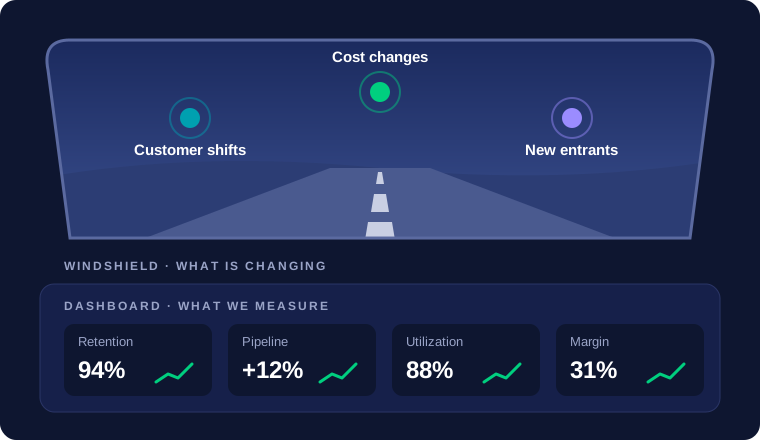
Consider a software company whose dashboard shows a healthy business: contracts renewing, products performing, forecasts on track. Meanwhile, AI is making it easier for customers to assemble some of the capabilities they used to buy. The more important development is happening in the economics of software development and the capabilities of customers, and the dashboard won’t show it until late.
The risk is becoming increasingly precise about a business model whose assumptions are shifting. It is why competitive intelligence needs to extend beyond familiar competitors to enabling technologies, cost structures, distribution, and what new entrants can now do.
AI changes what deserves attention
Much of AI’s immediate value comes from making existing work faster or cheaper, and dashboards capture that well. If AI cuts software development time by 40%, the productivity gain shows up. The bigger question is whether it changes the products the company should build, the customers it can serve, or the markets it should enter. Those implications are often larger than the operational improvements we can measure today.
More analytical capability doesn’t automatically produce more strategic understanding, either. AI makes it easier to construct persuasive explanations from existing evidence, but those explanations depend on which information is available and whether the organization is asking the right questions. A highly sophisticated analysis of an incomplete picture is still incomplete.
Commitments in a world of shorter visibility
Long-term planning remains necessary. But when visibility shortens, the structure of commitments matters more: the cost of being wrong, the time required to change direction, and the value of keeping alternatives open. Some investments deserve conviction because the underlying need is durable. Others are better made through smaller commitments, partnerships, experiments, or staged investment.
A company unsure which AI applications will dominate its industry in five years can still invest in data quality, technical architecture, customer relationships, and the ability to experiment. Those capabilities support several possible futures. The organization is investing in its ability to respond as the future becomes clearer.
Stay close to the work
Every layer of reporting makes information easier to consume and strips out context. A customer complaint becomes a category. An operational workaround becomes a process exception. An employee’s concern becomes a status update. The report can be accurate and still miss what matters. In security and operational risk especially, knowing how a business will behave under unfamiliar conditions takes conversations, simulations, and direct observation, not only metrics. Leaders need to know what their metrics cannot tell them.
Building the capability to notice change
- Look beyond established categories. Track adjacent markets, enabling technologies, and new business models, especially those that challenge how value is created.
- Observe directly. Spend time with customers, operational teams, and partners, and look for gaps between formal reporting and lived experience.
- Make assumptions visible. Name the expectations behind strategic decisions so it’s clear when new information should change them.
- Experiment. Controlled experiments provide evidence that historical data cannot.
- Revisit commitments. Separate investments that build durable capability from those that depend on uncertain forecasts.
None of this helps unless the organization can act on what it notices: test the opportunity, move resources, and change how it operates.
What boards and executives should be asking
Most board reporting is built to show progress against an agreed plan. When market assumptions change quickly, oversight also needs to test whether the plan still holds:
- What assumptions about our business model are becoming less reliable?
- What developments outside our industry could change how we create value?
- Where might our metrics be giving us confidence in an advantage that is eroding?
- Which capabilities would make us more adaptable across several plausible futures?
- What have we learned recently that should change an investment or a priority?
Knowing where we’re headed
The answer isn’t less measurement. Organizations need reliable information about how they operate, and AI can make that far more effective. But as analysis becomes more powerful and widely available, the advantage shifts to what leaders notice, which assumptions they challenge, and how quickly their organizations learn.
A smarter dashboard can tell us exactly where we are. It cannot tell us which destination is worth pursuing.
After all, isn’t the real question where we’re headed?
References
Katie McCadden and Andrew Spencer, The Attention Advantage: Why AI Is Making Human Attention, Not Intelligence, the Scarcest Resource in Leadership, Part One. Harvard Business Impact, October 30, 2026.