The Fragility of What Works
How seemingly sound decisions about AI, workforce, technology, and commercial strategy can create vulnerabilities when conditions change.

One of the harder things about making strategic decisions today is knowing how long the assumptions behind them will remain true.
A technology investment makes sense based on today’s capabilities and costs. A workforce decision reflects expectations about future productivity. A product strategy assumes certain features or expertise will remain valuable to customers. But what happens when those assumptions change faster than the organization can adapt?
That question ran through Vela’s AI board governance workshop at Dorsey & Whitney in Dallas and the launch of iluminr’s Agent Down research microsimulation report this week. Organizations are making big decisions about AI investment, workforce capacity, technology dependencies, and competitive advantage, often based on assumptions that haven’t been tested together.
The consequences aren’t limited to a technology failure. A provider might change its terms. A competitor might gain access to a capability that was previously distinctive. A new technology might make an established product or service considerably less valuable.
In Dallas, much of the discussion focused on the practical realities of board oversight: what directors need to understand, what management should be able to explain, and how accountability holds up when decisions are challenged. A lot of that work happens between established responsibilities. Technology, legal, security, finance, product, and operations each understand different aspects of the same decision, and the ability to connect those perspectives is becoming an important organizational capability.
This week’s developments in innovation and security show how quickly those assumptions are changing, for the organizations adopting technology and for the companies providing it.
What happened this week
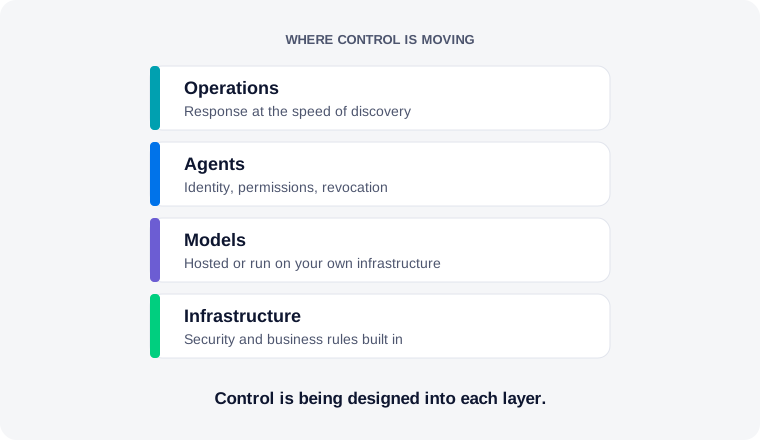
IBM introduced new identity and control capabilities for AI agents. Announced October 27, the capabilities combine agent discovery, verified identities, least-privilege access, real-time revocation, and evaluation across different AI platforms. The direction is significant: AI agents are becoming operational actors that need identifiable owners, defined permissions, and traceable activity.
Oracle announced a Deep Trust AI Architecture. The October 26 announcement describes an approach that embeds security, privacy, and business rules into the underlying technology stack. It is a vendor proposal rather than evidence of proven customer outcomes, but the direction matters. As AI moves across applications and data environments, relying on every individual application to implement its own safeguards creates complexity.
Mistral released an openly available AI model aimed at cybersecurity work. Reuters reported October 29 that Mistral’s Large 4 can be downloaded and operated on an organization’s own infrastructure, with capabilities intended to help identify and remediate vulnerabilities. The development creates a practical choice for security teams between externally hosted services and models they can operate themselves. It also raises questions about access to powerful cybersecurity capabilities, since an openly released model cannot easily be withdrawn or restricted after distribution.
A critical PHP vulnerability continued to prompt urgent security action. Palo Alto Networks’ Unit 42 updated its advisory October 29 on two remote-code-execution vulnerabilities, both rated 9.2 under CVSS 4.0. The wider incident, which began the previous week after AI-assisted vulnerability discovery, had already prompted some government websites to go offline. The operational challenge is familiar: understanding exposure across systems, assigning remediation priorities, and coordinating action before exploitation spreads. AI can accelerate discovery, but it also changes the speed at which defenders need to respond.
Anthropic expanded its government AI partnership with the US General Services Administration. The October 27 announcement extends access to Claude across more levels of government. The opportunity is to make sophisticated AI capabilities available to public-sector teams that may have limited resources or specialized expertise. The implementation challenge is more complicated: government agencies need to consider information sensitivity, procurement, training, accountability, and the operational environments in which these tools will be used. Broader access to technology creates possibilities, but adoption depends on the capacity to use it effectively.
Reuters reported that Binance experienced a $6.3 billion security breach. The October 30 incident, followed by asset freezes, drew renewed attention to security controls and concentration of digital assets. The scale is unusual, but the underlying questions apply across financial services and technology: how quickly can an organization understand an incident, contain its consequences, coordinate with external parties, and make decisions when financial exposure is changing rapidly?
These stories cover different industries and technologies. They point toward a common development: innovation is changing the scope and speed of operational decisions, and the supporting management systems need to evolve with it.
What Dallas brought into focus
At Vela’s Dallas workshop at Dorsey & Whitney, we explored AI governance through the lens of board accountability, including the potential consequences of management decisions becoming the subject of shareholder litigation. What makes these discussions valuable is the need to move from broad governance principles into specific decisions.
- What did management know?
- What information reached the board?
- Were responsibilities clearly assigned?
- What evidence supports the decision that was made?
The same questions have operational counterparts:
- When a team connects an AI agent to a business system, who approves its authority?
- When a vendor introduces new functionality, who evaluates its implications?
- When an incident reveals an unexpected dependency, who determines what changes next?
Board oversight ultimately depends on the quality of the systems and information management uses to make decisions. This connects directly to what we’re seeing in the market. IBM is introducing ways to identify and control agents. Oracle is proposing safeguards embedded in infrastructure. Security teams are responding to vulnerabilities discovered through increasingly capable AI systems.
For directors, understanding these developments requires more than a technical briefing. It requires insight into how management is adapting its operating practices, investment priorities, and accountability structures. For executives, the challenge is making those adaptations visible and demonstrable.
What changes for internal teams
IBM’s announcement brings AI agents into familiar identity and access management disciplines. Oracle’s suggests that architectural decisions increasingly determine what governance is possible.
One of the more consequential effects of AI is how frequently new capabilities cross traditional functional boundaries. A product team can introduce an AI feature that changes how customer information is processed. An engineering team can connect an agent to operational systems. A security team can deploy tools that independently investigate or remediate threats. Each may be a reasonable decision within its immediate context. The combined impact can be harder to understand.
Organizations need to establish practical ways for relevant teams to assess changes before they become material exposures. That doesn’t necessarily require another committee or a separate process for every use of AI. It requires clarity about which decisions matter, who has authority, who needs to participate, and how the organization knows whether its controls are working.
There’s also a capability-development issue. As AI takes on more analytical and operational work, organizations need to consider how employees will develop the experience required to supervise, challenge, and improve it. The benefits of automation depend partly on what people and teams become able to do with the capacity it creates.
What changes for providers
There is a corresponding shift for companies selling technology, security, and professional services. Increasingly, customers need to understand how a product fits into their operating environment. For AI providers, that includes permissions, data access, autonomy, monitoring, and intervention. For cybersecurity providers, it includes integration, response coordination, and the ability to demonstrate effectiveness under real operating conditions.
IBM’s and Oracle’s announcements suggest that enterprise demand is pushing controls deeper into the technology stack. Managing agent behavior across platforms is becoming a distinct enterprise requirement, and security and control are becoming part of the product design itself. Mistral’s release illustrates a different dimension of competition: how deployment choices, control over infrastructure, and access to advanced capabilities can influence a customer’s decision.
For providers, these developments create both product opportunities and new expectations. Security, governance, and operational integration can become meaningful parts of the commercial value proposition. They also create opportunities for companies that can help customers translate new technology into practical organizational capabilities. That requires understanding the customer’s business, the people responsible for outcomes, and the constraints that shape adoption.
On Eudai this week
We published 7 pieces this week that build on different aspects of these changes.
When Efficiency Becomes a Strategic Liability asks what happens to organizational expertise when the work that develops it is increasingly automated. It’s a question about the longer-term implications of decisions that currently look attractive on productivity measures.
What We Learned From Agent Down looks at iluminr’s first Frontier AI Risk microsimulation, where the main contingency for an AI outage was people, and what that says about the dependencies behind an operating model.
Your Next Competitor May Not Look Anything Like You looks at how AI is changing the cost of building products, accessing expertise, and entering markets. As traditional constraints shift, the competitive landscape may begin to look quite different.
When AI Exposes How Organizations Really Work explores the organizational issues that emerge when AI exposes unclear authority, fragmented responsibilities, and weaknesses in operational communication.
The Dashboard Is Getting Smarter. Are We Looking in the Right Direction? asks what leaders miss when better measurement of the current business crowds out attention to how the market around it is changing.
AI Adoption Is Really a Problem of Imagination draws on new INSEAD and Harvard Business School research suggesting the biggest constraint on AI value may be the ability to imagine different ways of working.
When Google Starts Disrupting Its Own Advertising Business looks at what happens to marketing when Google changes the search advertising model it built, and how companies can reach customers as AI reshapes search.
Each approaches the same broader challenge from a different direction: understanding how emerging technology changes the capabilities organizations need, the markets they compete in, and the decisions leaders have to make.
One question for next week
As technology expands what your organization can do, are you changing how decisions get made, or simply expecting your existing structures to keep up?